

What are kanji?
Kanji (漢字, かんじ) are the characters of Chinese origin that Japanese uses alongside hiragana and katakana: each one carries a meaning, and most have more than one reading. 山, for example, means “mountain” and is read やま (yama) on its own, but サン (san) in 富士山 (ふじさん, Fujisan, Mount Fuji). Japan’s official list for general use, the 常用漢字表 (じょうようかんじひょう, jōyō kanji hyō), has had 2,136 kanji since 2010. You don’t need all of them to start: the 80 to 100 or so at N5 already cover dates, numbers, prices, and many everyday words.
Three scripts in one sentence
An ordinary Japanese sentence mixes all three scripts. Take 毎朝コーヒーを飲みます。 (“I drink coffee every morning.”):
- Kanji write the core of the words: 毎朝 (まいあさ, every morning) and the 飲 in 飲みます (のみます, to drink).
- Hiragana writes the grammar: the particle を and the ending みます. See the hiragana chart.
- Katakana writes foreign words: コーヒー (coffee). See the katakana chart.
Japanese doesn’t put spaces between words, and kanji help you see where each one starts. They also tell apart words that sound the same: はし can be 橋 (bridge), 箸 (chopsticks), or 端 (edge).
Radicals: the building blocks of kanji
Many kanji are built from smaller pieces. The piece dictionaries use to file a kanji is its radical (部首, bushu). The traditional system, from the Chinese Kangxi dictionary (1716), has 214 radicals.
- 氵, the left-hand form of 水 (water), shows up in 海 (sea), 泳 (to swim), and 池 (pond).
- 亻, the form of 人 (person), next to 木 (tree) makes 休 (to rest): a person leaning against a tree.
- 日 (sun) and 月 (moon) together make 明 (bright).
A radical is a hint, not a rule: sometimes it points to the meaning, sometimes another piece points to the sound, and sometimes the origin is no longer visible. Recognizing the common pieces makes new kanji easier to remember.
On and kun readings
Most kanji have two kinds of reading. The on’yomi (音読み) comes from the Chinese pronunciation of the time the kanji reached Japan. The kun’yomi (訓読み) is a native Japanese word that came to be written with it. Dictionaries, and the official list itself, write on’yomi in katakana and kun’yomi in hiragana.
| Kanji | On’yomi | Kun’yomi |
|---|---|---|
| 山 (mountain) | サン: 富士山 (ふじさん, Mount Fuji) | やま: 山 (やま, mountain) |
| 水 (water) | スイ: 水曜日 (すいようび, Wednesday) | みず: 水 (みず, water) |
A useful tendency: a kanji on its own, or followed by hiragana, usually takes its kun’yomi; two or more kanji together usually take their on’yomi. It’s a tendency, not a rule (大人, adult, is read おとな). That’s why it pays to learn each kanji inside words, not as a list of loose readings.
Two terms you’ll keep meeting: okurigana is the hiragana that finishes a word after its kanji (the べる in 食べる, to eat), and furigana is the small kana reading printed above a kanji, used in manga for young readers and in texts for learners.
How many kanji should you learn?
- 2,136 are on the list for general use (常用漢字表), published by the Japanese government in 2010. Big dictionaries list tens of thousands, but most are rare.
- 1,026 are taught in the six years of Japanese elementary school (the 学年別漢字配当表, from the 2017 curriculum).
- The JLPT has no official list. Since its 2010 overhaul, the test publishes no kanji, vocabulary, or grammar lists; instead, it describes what you can do at each level. The numbers below are unofficial references.
| Level | Old test specification (until 2009) | Jonathan Waller’s lists (cumulative) |
|---|---|---|
| N5 | About 100 | 79 |
| N4 | About 300 | 245 |
| N3 | Didn’t exist: N3 was created in 2010 | 612 |
| N2 | About 1,000 | 979 |
| N1 | About 2,000 | 2,211 |
The old test had four levels. According to the JLPT, passing old levels 4, 3, 2, and 1 maps to passing N5, N4, N2, and N1; N3 sits between the old 3 and 2. Jonathan Waller’s lists are the ones learners use most, and Fluentei uses them to estimate the level of its readings. Treat the numbers as a ballpark: the test asks you to read kanji in sentences, not to recite a list.
30 N5 kanji to start with
Numbers, days of the week, people, and directions: all 30 below are on Jonathan Waller’s N5 list. The readings are the main ones on the official list; the full list has rarer ones too.
| Kanji | Meaning | On’yomi | Kun’yomi | Example | Strokes |
|---|---|---|---|---|---|
一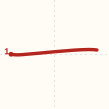 | one | イチ、 | ひと(つ) | 一つ (ひとつ), one (thing) | 1 stroke |
二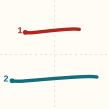 | two | ニ | ふた(つ) | 二人 (ふたり), two people | 2 strokes |
三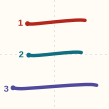 | three | サン | み(っつ) | 三日 (みっか), the 3rd (of the month); three days | 3 strokes |
十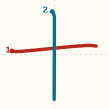 | ten | ジュウ、 | とお | 十日 (とおか), the 10th (of the month); ten days | 2 strokes |
百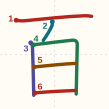 | hundred | ヒャク | — | 三百 (さんびゃく), three hundred | 6 strokes |
千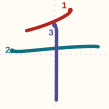 | thousand | セン | ち | 千円 (せんえん), a thousand yen | 3 strokes |
円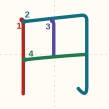 | yen; circle | エン | まる(い) | 百円 (ひゃくえん), a hundred yen | 4 strokes |
日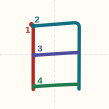 | day; sun | ニチ、 | ひ、 | 日本 (にほん), Japan | 4 strokes |
月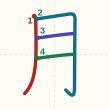 | moon; month | ゲツ、 | つき | 月曜日 (げつようび), Monday | 4 strokes |
火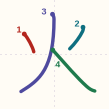 | fire | カ | ひ | 火曜日 (かようび), Tuesday | 4 strokes |
水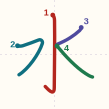 | water | スイ | みず | 水曜日 (すいようび), Wednesday | 4 strokes |
木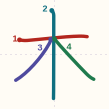 | tree; wood | ボク、 | き | 木曜日 (もくようび), Thursday | 4 strokes |
金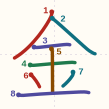 | gold; money | キン、 | かね | 金曜日 (きんようび), Friday | 8 strokes |
土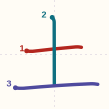 | earth; soil | ド、 | つち | 土曜日 (どようび), Saturday | 3 strokes |
年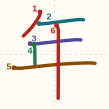 | year | ネン | とし | 一年 (いちねん), one year | 6 strokes |
人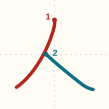 | person | ジン、 | ひと | 日本人 (にほんじん), Japanese person | 2 strokes |
子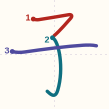 | child | シ、 | こ | 女の子 (おんなのこ), girl | 3 strokes |
女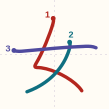 | woman | ジョ、 | おんな | 女の人 (おんなのひと), woman | 3 strokes |
男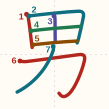 | man | ダン、 | おとこ | 男の子 (おとこのこ), boy | 7 strokes |
山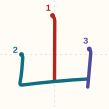 | mountain | サン | やま | 富士山 (ふじさん), Mount Fuji | 3 strokes |
川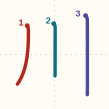 | river | セン | かわ | 小川 (おがわ), stream, brook | 3 strokes |
大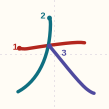 | big | ダイ、 | おお(きい) | 大学 (だいがく), university | 3 strokes |
小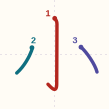 | small | ショウ | ちい(さい)、 | 小さい (ちいさい), small | 3 strokes |
上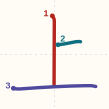 | above; to go up | ジョウ、 | うえ、 | 上がる (あがる), to go up, to rise | 3 strokes |
下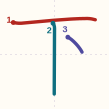 | below; to go down | カ、 | した、 | 地下鉄 (ちかてつ), subway | 3 strokes |
中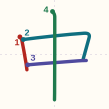 | inside; middle | チュウ | なか | 中国 (ちゅうごく), China | 4 strokes |
本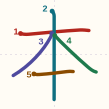 | book; origin | ホン | もと | 本屋 (ほんや), bookstore | 5 strokes |
学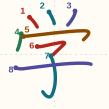 | study; to learn | ガク | まな(ぶ) | 学生 (がくせい), student | 8 strokes |
生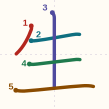 | life; to be born | セイ、 | い(きる)、 | 先生 (せんせい), teacher | 5 strokes |
先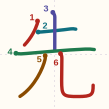 | before; ahead | セン | さき | 先週 (せんしゅう), last week | 6 strokes |
In the diagrams, each stroke has a number and a color in the order it’s written, with a dot where it starts. The parentheses in the kun readings mark the okurigana: ひと(つ) is written 一つ.
How to study kanji
- Learn kana first. Every kanji is read with hiragana or katakana, and dictionaries give the readings in kana. Start with hiragana.
- Learn kanji inside words. Learning 先生 (せんせい, sensei, teacher) and 生きる (いきる, ikiru, to live) teaches you two readings of 生, each with a real use.
- Read a lot, with furigana at first. Seeing the same kanji in different sentences fixes its reading and its meaning. Drop the furigana for the kanji you already know.
- Review by trying to remember. Read the word, try to say its reading and meaning, and only then check. Spacing reviews out works better than cramming them together; the method guide has the research.
- Write a few by hand, if you like. You don’t need it to read, but writing in stroke order helps you tell similar kanji apart, like 土 and 士.
Kanji in Fluentei
Fluentei teaches kanji through reading. Starting from zero, you learn hiragana and katakana in Fluentei RPG’s Kana Universe, then move on to N5.
- Fluentei RPG: you read the word in a real sentence and write it from memory, in kana. Get it right and your hero attacks.
- Readings by level, from N5 to N1, with furigana above the kanji, and Notebooks: readings and songs become a Notebook where you tap a word to see what it means in that line, and Ginga can explain the grammar in English.
- Review: the word you tap goes into your Vocabulary and comes back at the right time, with the line you found it in.
Frequently asked questions
What’s the difference between kanji, hiragana, and katakana?
Hiragana and katakana stand for sounds: each character is a syllable (か and カ are both “ka”). A kanji stands for an idea and can have several readings. In a sentence, hiragana writes the grammar, katakana the foreign words, and kanji the core of the words. The same word can be written in kanji or in kana: 山 and やま (yama) both mean “mountain”.
How many kanji are there?
There’s no fixed number: big dictionaries list tens of thousands, but most are rare. The practical reference is the official list for general use, with 2,136 kanji; 1,026 of them are taught in the six years of Japanese elementary school.
How many kanji are on the JLPT N5?
The JLPT hasn’t published an official kanji list since 2010. By Jonathan Waller’s unofficial lists, the ones learners use most, N5 has 79 kanji; the old test’s specification put the matching level at about 100.
Do I need kanji to speak Japanese?
To speak, no: kanji are writing. To read signs, menus, manga, and subtitles, yes. Everyday Japanese is written with kanji, and a text in hiragana alone is hard to read.
How do I know how a kanji is read?
From the word it’s in. 水 (water) is read みず (mizu) on its own and すい (sui) in 水曜日 (すいようび, suiyōbi, Wednesday). In texts for learners, furigana shows the reading in kana above the kanji; elsewhere, a Japanese dictionary gives the readings with example words.
Which app should I use to study kanji?
It depends on how you like to study. WaniKani is built around kanji and vocabulary, with radicals and spaced reviews; Anki reviews flashcard decks, made by you or shared by other learners. In Fluentei, you learn kanji by reading: in Readings and Notebooks, Ginga explains the word you tap in English, and it comes back in Review with the line it appeared in.
Are Japanese kanji and Chinese characters the same thing?
They share an origin, and many mean the same, but the pronunciation is different, and some of the shapes changed differently in each country. Mainland China uses simplified characters, and Japan made simplifications of its own.
How do you write “love” in kanji?
愛 (あい, ai) is love in general; 恋 (こい, koi) is romantic love. Other favorites: 力 (ちから, chikara, strength), 平和 (へいわ, heiwa, peace), and 家族 (かぞく, kazoku, family). For a tattoo, check the meaning and the shape with someone who reads Japanese.
How long does it take to learn kanji?
There’s no honest number that fits everyone. It depends on how many hours you read each week and how many kanji you need for what you want to read. A concrete goal, like the 80 to 100 or so at N5, is more useful than “learning them all”.
Keep going
- How to learn Japanese on your own: a step-by-step guide
- Hiragana chart with audio and stroke order
- Katakana chart with audio and stroke order
- Everyday Japanese phrases
- How you actually learn a language
Sources
- Agency for Cultural Affairs, Japan (文化庁). 常用漢字表 (Cabinet Notice No. 2, November 30, 2010): 2,136 kanji; on’yomi in katakana and kun’yomi in hiragana. bunka.go.jp
- Ministry of Education, Japan (文部科学省). The 2017 elementary-school curriculum, with the kanji list by grade (1,026 kanji, in force since 2020). mext.go.jp
- JLPT. Frequently asked questions: why the test content specifications stopped being published in 2010, and how the current levels map to the old ones. jlpt.jp
- Japanese Language Proficiency Test: Test Content Specifications (revised edition, 2004), as summarized on Wikipedia.
- JLPT kanji lists by Jonathan Waller, tanos.co.uk, under a Creative Commons Attribution (CC BY) license. Cumulative counts by Fluentei.
- Kangxi radicals. Wikipedia
- Stroke order derived from KanjiVG, © Ulrich Apel and contributors, under the CC BY-SA 3.0 license (diagram notice). See Sources and licenses.
Meet Fluentei
Fluentei is a platform for learning Japanese by reading, listening, and speaking: original songs, readings, and videos by level (N5 to N1), Microscenes, games, and conversation with Ginga, with every sentence explained in English.
 Opens in a new tab.
Coming soon to Google Play.